Table of contents
Weight loss is one of the few areas of medicine where the science genuinely changed under our feet. A class of injectable peptides now produces results that diet and exercise alone rarely match. The catch is that "peptides for weight loss" lumps together two very different things, and only one of them has the evidence to back the headlines.
On one side are the GLP-1 medicines, semaglutide and tirzepatide, FDA-approved, prescription, and backed by large clinical trials. On the other are the growth-hormone peptides, CJC-1295, ipamorelin, and the rest, which can shift body composition at the margins but have thin direct weight-loss evidence and several of which are not even legally available right now. This guide ranks all seven honestly, tells you which category each belongs to, what to track on each, and where they fit into a plan that is actually monitored rather than mailed out and forgotten.
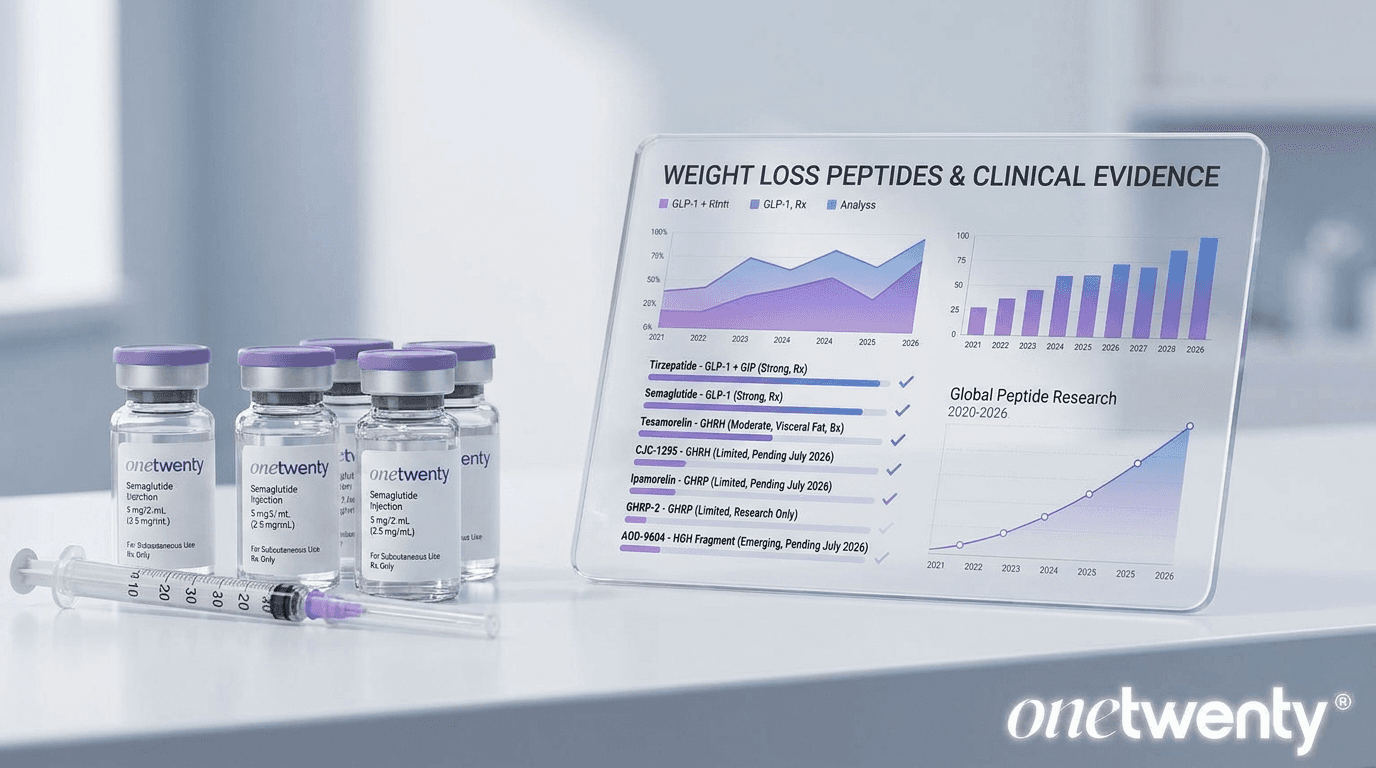
Weight-loss peptides in 2026 · the numbers
Two categories, not one
The single most useful thing to understand here is that these seven peptides split into two groups that do not belong in the same sentence. The GLP-1 drugs work on gut-hormone signaling that controls appetite and fullness, and the trials behind them are large and rigorous. In large randomized clinical trials combined with lifestyle intervention, semaglutide produced average weight loss of approximately 15% of body weight, while tirzepatide achieved average reductions exceeding 20% at the highest doses. Those figures come from trial participants receiving structured diet and activity support, not from the average patient in routine practice, but the magnitude is still genuinely different from anything that came before.
The growth-hormone peptides work by nudging your own growth hormone up. That can support fat metabolism, recovery, and lean mass at the edges, but the controlled evidence that they cause meaningful weight loss in healthy adults is limited, and they are better thought of as body-composition tools than weight-loss drugs. Several are also injectables sitting behind the FDA advisory review scheduled for July 2026, so they are not legally compounded right now. Keep that split in mind as you read the rankings.
Evidence vs what you can actually get
Where the weight-loss peptides land
Strength of direct weight-loss evidence plotted against how accessible each one is right now.
Weight-loss peptides plotted by how strong the direct evidence is against how accessible they are right now. The GLP-1 drugs sit top right: strong evidence and FDA-approved. Tesamorelin is approved but targets visceral fat rather than the scale. The growth-hormone peptides cluster bottom left, where the evidence is thin and most are pending the July 2026 review.
The seven, ranked honestly
| Rank | Peptide | Class | What it does | Evidence | Availability |
|---|---|---|---|---|---|
| 1 | Tirzepatide GLP-1 + GIP | Incretin drug | Appetite control, largest weight loss | Strong | Available (Rx) |
| 2 | Semaglutide GLP-1 | Incretin drug | Appetite control, proven weight loss | Strong | Available (Rx) |
| 3 | Tesamorelin GHRH analog | GH axis | Targets visceral fat specifically | Moderate | Available (Rx) |
| 4 | CJC-1295 GHRH analog | GH axis | Body composition and recovery | Limited | Pending Jul 2026 |
| 5 | Ipamorelin GHRP, selective | GH axis | Gentle GH rise, no appetite spike | Limited | Pending Jul 2026 |
| 6 | GHRP-2 GHRP, potent | GH axis | Strong GH rise, raises appetite | Limited | Research only |
| 7 | AOD-9604 HGH fragment | GH fragment | Fat metabolism, weak human results | Emerging | Pending Jul 2026 |
Ranking reflects the balance of weight-loss evidence, mechanism, and how realistically you can access each one today. The gap between the top two and the rest is large and deliberate.
The peptides, one by one
Tirzepatide
Available (Rx)Tirzepatide is a once-weekly injection that activates two gut-hormone receptors, GLP-1 and GIP, which together blunt appetite, slow stomach emptying, and improve how the body handles insulin. In the SURMOUNT-1 trial it produced the biggest weight loss of any drug in this category, up to about 22.5 percent of body weight at the highest dose over roughly seventy-two weeks, with better muscle preservation than dieting alone. It is FDA-approved for both weight management and type 2 diabetes.
Semaglutide
Available (Rx)Semaglutide is the once-weekly GLP-1 injection that brought this category into the mainstream. It mimics a gut hormone that increases fullness and reduces food intake, and in the STEP-1 trial it produced average weight loss of about 14.9 percent of body weight over roughly sixty-eight weeks, with cardiovascular benefits documented separately. Like tirzepatide, it is FDA-approved for weight management and type 2 diabetes.
Tesamorelin
ModerateTesamorelin is a daily injection that stimulates the body's own growth hormone, and it is FDA-approved specifically to reduce excess visceral fat in people with HIV-associated lipodystrophy. Its strength is targeting the deep abdominal fat tied to metabolic risk rather than driving a large drop on the scale. It is not approved for treating obesity in the general population. Outside that approved use it is prescribed off-label, and the general-population weight-loss evidence is more limited than its visceral-fat data, so readers should not assume it is a third FDA-approved weight-loss peptide.
CJC-1295
Pending Jul 2026CJC-1295 is a long-acting analog of growth-hormone-releasing hormone that prompts the pituitary to release more growth hormone, often stacked with ipamorelin. The body-composition logic is more fat oxidation plus better recovery and sleep. The direct, controlled weight-loss evidence in healthy adults is limited, and it is better understood as a recovery and body-composition tool than a weight-loss drug.
Since the realistic benefit is body composition and recovery, those trends are the honest test. Because growth hormone can reduce insulin sensitivity, periodic monitoring of fasting glucose and HbA1c may be appropriate during GH-axis therapy, though insulin resistance is not an expected outcome in every user. See the full biomarker and biometric library.
Ipamorelin
Pending Jul 2026Ipamorelin is a selective growth-hormone-releasing peptide valued because it raises growth hormone without the appetite spike or cortisol bump seen with stronger secretagogues, which is why it is usually paired with CJC-1295. As with CJC-1295, the honest case is body composition and recovery rather than meaningful scale weight, and the controlled weight-loss data is thin.
GHRP-2
Research onlyGHRP-2 is a potent growth-hormone secretagogue. It reliably raises growth hormone, but it also tends to increase appetite, which works directly against a weight-loss goal, and it can raise cortisol. There is little controlled evidence supporting it as a weight-loss agent specifically.
AOD-9604
Pending Jul 2026AOD-9604 is a fragment of human growth hormone designed to capture its fat-burning signal without the growth effects. The idea is appealing, but the clinical reality has been underwhelming: the most-cited human trial did not show meaningful weight loss versus placebo. The mechanism is interesting, the human results are not.
Do peptides actually cause weight loss?
The honest answer
It depends entirely on which peptide
The drug is one input, the monitoring is the product
A GLP-1 prescription is the start of the work, not the end of it. Done well, it is titrated to your response, paired with enough protein and resistance training to protect muscle, and tracked against labs that show whether your metabolic health is genuinely improving, fasting glucose and insulin, HbA1c, lipids, and liver markers, not just the number on the scale. Done poorly, it is a script mailed out with no follow-up and no idea whether you are losing fat or muscle.
OneTwenty's membership is built for the first version. Quarterly comprehensive panels, continuous data from your connected devices, and an AI coaching layer that reads it together, with treatment, where appropriate, handled and titrated by independent licensed providers against your actual numbers. If a GLP-1 is right for you, OneTwenty offers semaglutide and tirzepatide with that monitoring built in. For the full baseline, start with our longevity blood test guide.
Make the injection part of a plan, not the whole plan.
OneTwenty pairs comprehensive testing with connected-device data and clinician-supervised care, so if a GLP-1 is right for you it is titrated and tracked against your real metabolic markers rather than mailed out and forgotten. Laboratory monitoring is individualized according to your clinical status, treatment response, and the prescribing clinician's judgment. The legal peptide formulary and bioidentical HRT are available now, with the rest added as the FDA process clears them.
Weight-loss peptides FAQ
Do peptides actually work for weight loss?
The GLP-1 peptides, semaglutide and tirzepatide, do, with large weight loss documented in clinical trials. The growth-hormone peptides have limited direct evidence for weight loss and are better described as body-composition tools. If weight loss is the goal, the GLP-1 drugs lead by a wide margin.
What is the difference between semaglutide and tirzepatide?
Semaglutide activates one gut-hormone receptor, GLP-1. Tirzepatide activates two, GLP-1 and GIP, and in trials it generally produced larger weight loss (up to about 22.5 percent versus around 15 percent). Both are once-weekly prescription injections, FDA-approved, and work by reducing appetite and food intake. OneTwenty offers semaglutide and tirzepatide.
Are growth-hormone peptides like CJC-1295 good for fat loss?
They can support fat metabolism and recovery at the margins by raising growth hormone, but the controlled weight-loss evidence is limited, and they are not a substitute for the GLP-1 drugs. Most of the injectable ones are also pending the July 2026 FDA review, so they are not legally compounded right now.
Are weight-loss peptides safe?
The GLP-1 drugs have well-characterized side effects, mostly gastrointestinal, and eligibility criteria, so they need a licensed clinician. The growth-hormone peptides are less studied for this use. Either way, this is medical care that should be supervised, with baseline labs and follow-up.
Are peptides like CJC-1295 or AOD-9604 legal right now?
Both are among the compounded peptides awaiting the FDA advisory review scheduled for July 23 to 24, 2026. Until that review and the guidance behind it publish, they are not legally compounded or dispensed. Semaglutide and tirzepatide are different: they are FDA-approved prescription medicines obtained through a licensed provider. See our guide to getting legal peptides online.
Sources & references
- Wilding JPH et al. Once-Weekly Semaglutide in Adults with Overweight or Obesity (STEP 1), NEJM (2021); mean weight loss 14.9%. nejm.org
- Jastreboff AM et al. Tirzepatide Once Weekly for the Treatment of Obesity (SURMOUNT-1), NEJM (2022); up to 22.5% weight loss. nejm.org
- FDA prescribing information for tesamorelin (Egrifta), indicated to reduce visceral adipose tissue in HIV-associated lipodystrophy.
- AOD-9604 human weight-loss trial: no significant difference versus placebo (peer-reviewed obesity literature).
- FDA Pharmacy Compounding Advisory Committee meeting, July 23 to 24, 2026, reviewing compounded peptides (docket FDA-2025-N-6895). fda.gov
OneTwenty is a health technology company, not a medical provider, pharmacy, or laboratory. Clinical services are delivered by independent licensed providers. This article is educational and is not medical advice. Semaglutide, tirzepatide, and tesamorelin are prescription medicines with eligibility criteria and possible side effects, and should only be used under the care of a licensed clinician. Talk to a qualified clinician before starting any peptide or weight-loss treatment.
Fact Checked
Dr. Mohammed A. Fouda, MD
Dr. Fouda is a Neurosurgery research scholar. His work focus primarily on Brain tumor behavior and quality of life of cancer patients as well as biomedical engineering and medical device innovation.



How OneTwenty Works
Not your average
Checkup.
Every life stage brings new biological demands. Tracking the right metrics at the right time helps you adapt, optimize performance, and extend both lifespan and healthspan.
Your Annual Physical
Manual Data Processing
Guesswork Trend Detection
Once-a-year physical
Reactive, tested when sick
No data between visits
Once a year testing
Delayed Results
One-size dosing, set and forget
Real-Time Trend Insights
Daily smart-device data
Automated Data Sync
Quarterly Biomarker Tests
Optimal, personalized targets
Plain-language AI insights
Medications titrated to your data
Built to extend healthspan

Frequently Asked Questions
Clarity before
you commit
Answers on setup, scale, and support to remove blockers.